From Spain to Morocco: Preparing for the 2027 Total Solar Eclipse Through the NATE Project
A Moroccan perspective on international collaboration, scientific discovery, and capacity building in Africa


On 12 August 2026, the city of Palencia in northern Spain became a meeting point for scientists, students, and astronomy enthusiasts from different countries, all gathered to witness and study one of nature’s most spectacular phenomena: a total solar eclipse.
The eclipse will last only a few minutes, but the curiosity it inspires could last a lifetime.
From the shadow of Spain to the skies of Morocco
For our Moroccan team, this event represented much more than an extraordinary astronomical experience. It marked an important milestone in our preparations for the total solar eclipse of 2 August 2027, when the Moon’s shadow will cross northern Morocco and other parts of North Africa.
As the Moroccan lead of the North African Telescope Eclipse (NATE) Project, I had the opportunity to contribute to an international effort that brings together scientific expertise, advanced instrumentation, and a shared ambition to explore the solar corona while developing new observational capabilities in Morocco.
NATE is an international scientific initiative led by the Instituto de Astrofísica de Canarias (IAC) in collaboration with Mohammed VI Polytechnic University (UM6P) in Morocco and the U.S. National Science Foundation National Solar Observatory (NSF NSO).
The project aims to establish a coordinated network of telescopes across Morocco to observe the 2027 total solar eclipse, combining scientific research with education, public outreach, and training opportunities for students, teachers, researchers, and volunteers.
Our participation in the 2026 eclipse campaign in Spain was therefore a crucial first step. It allowed the Moroccan team to work alongside experienced international solar physicists, familiarize ourselves with the observational equipment, and understand the technical and organizational challenges associated with a large-scale eclipse campaign.
More importantly, it gave us the opportunity to transform an ambitious scientific concept into practical experience.
Learning by doing: the Moroccan team’s experience in Spain
One of the central objectives of the 2026 campaign was to bring together participants who will contribute to the 2027 observations and provide them with practical training under real eclipse conditions.
In Palencia, the observing teams worked with multiple telescopes, cameras, and data acquisition systems designed to capture images of the solar corona during totality. For our Moroccan participants, this was a particularly valuable opportunity to gain hands-on experience with the instruments that will be deployed during the 2027 campaign.

Working alongside scientists from the IAC, NSF NSO, and the University of Colorado Boulder, our team participated in technical training sessions covering telescope assembly, mount balancing, polar alignment, camera configuration, focusing, solar tracking, and observational procedures.
We particularly benefited from the expertise of Dr. Kevin Reardon, Dr. Sanjay Gosain, Sarah Bruce, and Denise Yudovich, who contributed to the training and scientific preparation of the observing teams. These activities highlighted an essential aspect of the NATE philosophy: scientific collaboration is not simply about sharing data or equipment; it is also about transferring knowledge and developing local expertise.
The experience was especially meaningful because many participants were preparing to observe a total solar eclipse for the first time. For several months, the international team had worked on the preparation of the observational campaign. Yet, when the moment finally arrived, the available observing window lasted just over 100 seconds.
This contrast between months of preparation and less than two minutes of totality demonstrated the importance of careful planning and technical readiness. During the campaign, we learned that even seemingly minor issues, such as imperfect focusing, inaccurate telescope alignment, or difficulties with tracking, can significantly affect the quality of the scientific observations. These lessons are now directly informing our preparations for Morocco in 2027.
Observing the solar corona: the scientific ambition behind NATE
Although total solar eclipses are spectacular events for the public, they also provide exceptional scientific opportunities.
During totality, the Moon completely blocks the bright solar photosphere, revealing the much fainter outer atmosphere of the Sun, known as the solar corona.
The corona is an extremely dynamic environment shaped by the Sun’s magnetic field. Understanding its structure and evolution is essential for addressing several fundamental questions in solar physics, including the mechanisms responsible for coronal heating and the acceleration of the solar wind.

One of the major scientific objectives of NATE is to investigate the evolution of coronal structures through coordinated observations from multiple geographical locations. The project builds on the experience of the Citizen Continental-America Telescopic Eclipse (Citizen CATE) experiments conducted in the United States during the 2017 and 2024 total solar eclipses. These projects demonstrated the scientific potential of deploying similar telescopes at different locations along the path of totality.
At any individual observing site, totality lasts only a few minutes. However, by distributing telescopes along the eclipse path and coordinating their observations, it becomes possible to combine individual datasets into a much longer time sequence. This approach allows scientists to investigate how coronal structures evolve over time, providing information that cannot be obtained from a single observing location.
For the 2027 eclipse, NATE aims to apply this strategy through a coordinated network of telescopes in Morocco. The geographical extent of the eclipse path across northern Morocco provides an opportunity to establish multiple observing stations, each contributing to a common scientific dataset.
The resulting observations will support studies of the morphology, dynamics, and temporal evolution of the solar corona. They may also contribute to improving numerical models of the solar magnetic field and our understanding of the physical processes responsible for space weather.
Preparing Morocco for the historic eclipse of 2027
The total solar eclipse of 2 August 2027 will be an extraordinary event for Morocco and the broader North African region.
Unlike the 2026 eclipse in Spain, where the Sun was relatively low in the sky during totality, the 2027 eclipse will occur with the Sun at a considerably higher elevation. Across parts of the wider eclipse path, totality will last more than six minutes, providing particularly favorable opportunities for detailed observations of the solar corona.
For NATE, Morocco will play a central role in the organization and deployment of the observational network.
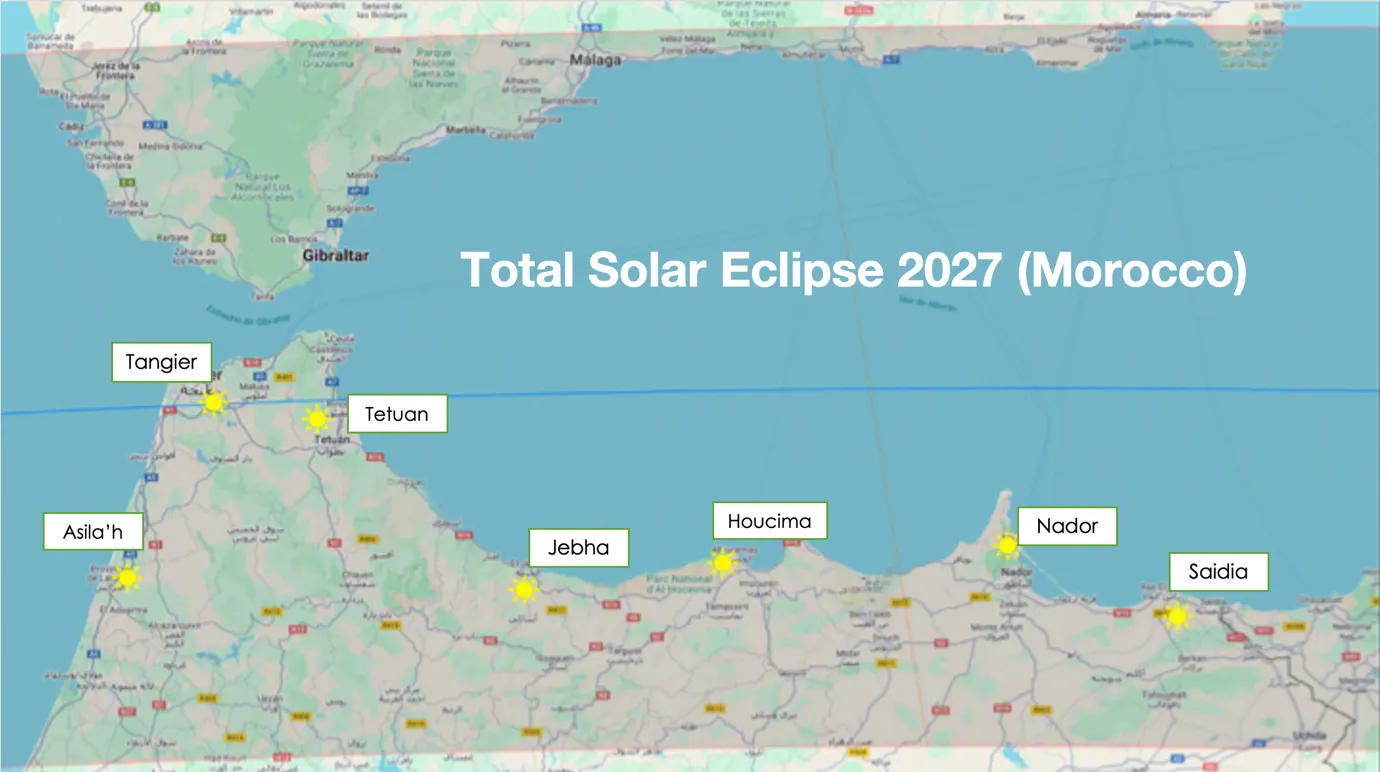
As the Moroccan team lead, one of my main responsibilities is to coordinate the national participation and contribute to the development of the observing infrastructure and local scientific teams.
Our preparations include identifying suitable observation sites, organizing volunteers, coordinating with local authorities, and establishing partnerships with educational institutions and associations. We are particularly considering locations in northern Morocco, including Tangier, Tetouan, Martil, and Asilah, as part of our observational and outreach planning.
Selecting appropriate sites requires much more than identifying locations within the path of totality. Each station must have a sufficiently open horizon, suitable weather prospects, reliable power supplies, appropriate access for equipment and personnel, and adequate communication infrastructure. We must also ensure that the telescope systems are properly calibrated and that the observing teams can operate them independently.
The experience gained in Palencia has been extremely valuable in identifying these requirements.
Following the 2026 campaign, our Moroccan team has continued sharing technical knowledge through meetings and presentations. Participants have discussed practical challenges encountered during the observations, including focusing difficulties, telescope alignment, tracking accuracy, and data management. These discussions are helping us refine our procedures and establish a more standardized approach for the 2027 campaign.
Our objective is to ensure that each Moroccan observing station can collect scientifically useful data while operating as part of a coordinated international network.
Capacity building: creating opportunities for young Moroccan and African astronomers
Beyond its immediate scientific objectives, NATE represents an important opportunity to strengthen astronomy education and research capacity in Morocco.
As a researcher at Mohammed VI Polytechnic University, I consider this aspect particularly important. Morocco has significant potential to contribute to astronomical research, and initiatives such as NATE can help develop the technical expertise and collaborative networks needed to support future projects.
One of our priorities is to involve university students, high school students, teachers, young researchers, and volunteers in the preparation and execution of the 2027 observations. Through practical training, participants will acquire experience in astronomical instrumentation, observational planning, data acquisition, image processing, and scientific teamwork.

The collaboration with the IAC and NSF NSO provides access to expertise developed through previous eclipse campaigns and established solar physics research programs. This knowledge transfer is particularly valuable for developing local capabilities. Our ambition is not simply to participate in an international scientific campaign, but to ensure that Moroccan students and researchers become active contributors to its scientific outcomes.
We also hope that the experience gained through NATE will create opportunities for future collaborations involving African institutions.
The 2027 eclipse is a temporary astronomical event, but the expertise developed through its preparation can have a lasting impact. The trained observers, scientific partnerships, and technical knowledge established through the project could support future activities in observational astronomy, solar physics, and science education.
For me, this is one of the most important legacies that NATE can leave in Morocco.
Bringing the eclipse to the Moroccan public
The 2026 eclipse in Palencia also demonstrated the extraordinary potential of astronomy to engage the public. The city hosted a range of educational and outreach activities, including public lectures, family workshops, and community events organized by the IAC and its partners. Scientists, students, residents, and visitors gathered to share the excitement of the eclipse.
The atmosphere demonstrated that such events could create meaningful connections between scientific research and society. We hope to develop a similar approach in Morocco for the 2027 eclipse.

Alongside the scientific observing campaign, NATE includes a significant education and public outreach component. Our Moroccan team is exploring collaborations with schools, universities, local associations, and community organizations to organize educational workshops and public activities.
These initiatives will aim to introduce participants to solar physics, explain the astronomical mechanisms behind eclipses, and promote safe solar observation. We are also developing educational resources adapted to different age groups, allowing students to explore topics such as the Solar System, the Sun, and astronomical observations.
Special attention will be given to engaging young people in communities near the path of totality. For many students, the 2027 eclipse may represent their first direct encounter with observational astronomy. We hope that this experience will encourage some of them to pursue further studies in physics, astronomy, engineering, or related scientific disciplines.
The eclipse will last only a few minutes, but the curiosity it inspires could last a lifetime.
International collaboration with an African vision
One of the most rewarding aspects of the 2026 campaign was the opportunity to work closely with colleagues from different institutions and scientific backgrounds.
The collaboration between the IAC, NSF NSO, the University of Colorado Boulder, and UM6P illustrates the value of combining complementary expertise to achieve ambitious scientific objectives. The IAC brings extensive experience in solar physics and astronomical observations, while NSF NSO contributes expertise in solar instrumentation, eclipse campaigns, and scientific analysis. For UM6P, participation in NATE represents an opportunity to strengthen the development of astrophysics research and training activities in Morocco.
As the Moroccan lead, I see this collaboration as an important example of how international scientific partnerships can support the growth of astronomy across Africa.
However, I believe that the true value of such partnerships lies in their ability to create sustainable opportunities for local researchers and students. Our goal is to develop a strong Moroccan contribution to the scientific campaign, from telescope operations and data acquisition to subsequent analysis and interpretation.
The 2027 eclipse offers a unique opportunity to demonstrate that African institutions can play an active role in internationally coordinated astronomical research. It is also an opportunity to encourage stronger scientific connections between African universities, research centers, and the broader international astronomy community.
From Palencia to Morocco: looking ahead
The 2026 eclipse in Spain was an important milestone for the NATE collaboration. It allowed us to test observational procedures, evaluate instrumentation, develop technical skills, and strengthen the relationships between participating teams.
For our Moroccan participants, it was also an opportunity to experience firsthand the excitement and challenges of conducting scientific observations during a total solar eclipse. The lessons learned in Palencia are now guiding our preparations for the more ambitious campaign planned for August 2027.
Over the coming months, we will continue working on the selection of observation sites, technical training, equipment preparation, volunteer coordination, and public outreach activities. We also intend to maintain regular meetings among the Moroccan participants to ensure that knowledge gained during the Spain campaign is shared with the wider team.
The success of NATE will depend on careful preparation, effective coordination, and the dedication of everyone involved. Yet, beyond the technical and scientific objectives, the project carries a broader ambition. It is an opportunity to strengthen Morocco’s participation in international astronomy, inspire young people, and contribute to the development of scientific expertise across Africa.
A legacy beyond totality
For me, the most important lesson from the 2026 eclipse is that the success of a scientific campaign cannot be measured solely by the number of images collected or the quality of the resulting data. It must also be measured by the knowledge shared, the collaborations established, and the opportunities created for future generations.
The experience in Palencia reminded us that even the most sophisticated scientific instruments depend on people working together with a common purpose.
As we prepare to welcome the Moon’s shadow to Morocco on 2 August 2027, we are motivated by both the scientific possibilities and the opportunity to create something lasting. Through NATE, we hope to contribute to a better understanding of the solar corona while helping develop a new generation of Moroccan observers, researchers, and astronomy enthusiasts.
Our ambition is that when the Moon’s shadow leaves Morocco in August 2027, it will leave behind more than scientific images: it will leave a stronger astronomical community, new international partnerships, and a generation of young Africans inspired to explore the Universe.